

Connexion client
Connexion
S'inscrire
Créer un compte a de nombreux avantages :
- Voir la commande et suivre l'expédition
- Suivre l'historique des commandes
- Commander plus rapidement
Mon panier
Sous-total du panier
x
Montant :
Gratuit
Un ou plusieurs articles de votre panier nécessitent une prescription. Vous pouvez soumettre les détails de la (des) prescription(s) sur la page du panier.
Passer à la caisse
Voir et éditer le panier
Aucun article dans votre panier.
Efient Comp Pell 28 X 10mg
Sur prescription
Médicament
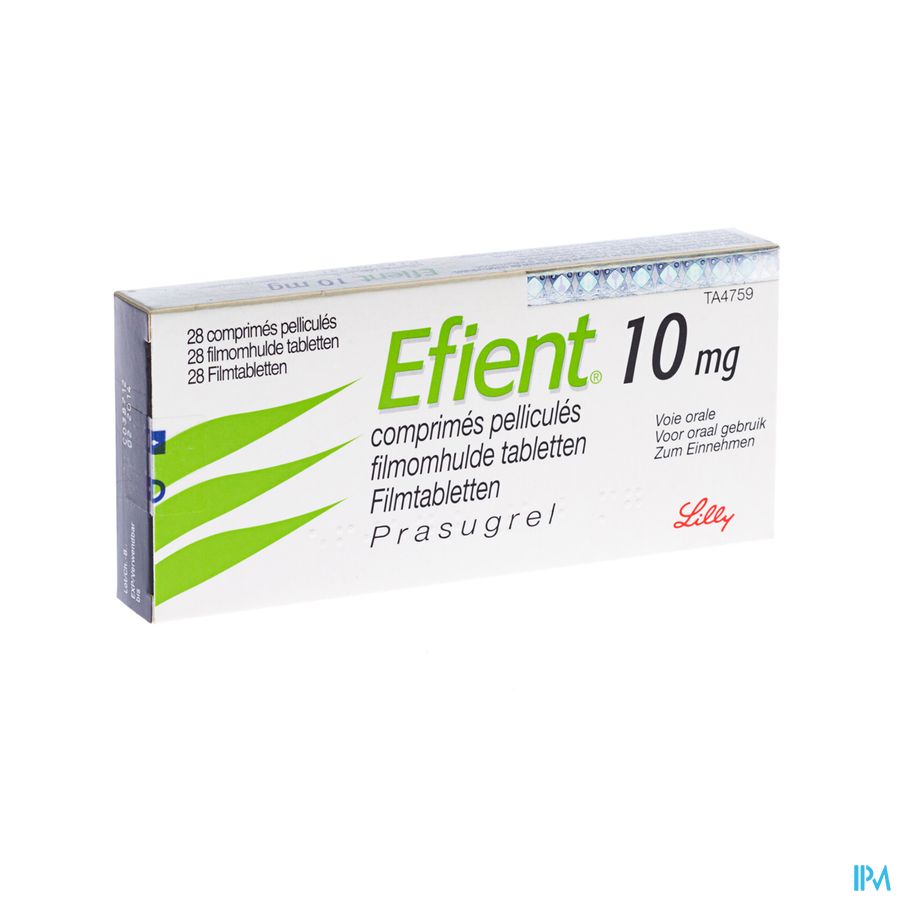
Efient Comp Pell 28 X 10mg
Sur prescription
Médicament
28,82 €
Prix Habituel
éligibles au remboursement
Si vous avez droit au remboursement de ce médicament, vous paierez le taux de remboursement en pharmacie et non le prix affiché sur notre webshop.
Prix avec remboursement standard
Vous payez : € 7,44 (6% TVA incluse)
Prix avec remboursement majoré
Vous payez : € 4,42 (6% TVA incluse)
Informations importantes
Ce médicament nécessite une ordonnance valide. Il ne peut pas être acheté en ligne et doit être payé à la pharmacie après examen par le pharmacien.
En rupture de stock
Veuillez nous contacter par téléphone ou par e-mail et nous examinerons ensemble les possibilités.
4.4 Special warnings and precautions for use Bleeding risk In the phase 3 clinical trial (TRITON) key exclusion criteria included an increased risk of bleeding; anaemia; thrombocytopaenia; a history of pathological intracranial findings. Patients with acute coronary syndromes undergoing PCI treated with Efient and ASA showed an increased risk of major and minor bleeding according to the TIMI classification system. Therefore, the use of Efient in patients at increased risk of bleeding should only be considered when the benefits in terms of prevention of ischaemic events are deemed to outweigh the risk of serious bleedings. This concern applies especially to patients: • ≥ 75 years of age (see below). • with a propensity to bleed (e.g. due to recent trauma, recent surgery, recent or recurrent gastrointestinal bleeding, or active peptic ulcer disease) • with body weight < 60 kg (see sections 4.2 and 4.8). In these patients the 10 mg maintenance dose is not recommended. A 5 mg maintenance dose should be used. • with concomitant administration of medicinal products that may increase the risk of bleeding, including oral anticoagulants, clopidogrel, non-steroidal anti-inflammatory drugs (NSAIDs), and fibrinolytics. For patients with active bleeding for whom reversal of the pharmacological effects of Efient is required, platelet transfusion may be appropriate. The use of Efient in patients ≥ 75 years of age is generally not recommended and should only be undertaken with caution after a careful individual benefit/risk evaluation by the prescribing physician indicates that benefits in terms of prevention of ischaemic events outweigh the risk of serious bleedings. In the phase 3 clinical trial these patients were at greater risk of bleeding, including fatal bleeding, compared to patients < 75 years of age. If prescribed, a lower maintenance dose of 5 mg should be used; the 10 mg maintenance dose is not recommended (see sections 4.2 and 4.8). Therapeutic experience with prasugrel is limited in patients with renal impairment (including ESRD) and in patients with moderate hepatic impairment. These patients may have an increased bleeding risk. Therefore, prasugrel should be used with caution in these patients. Patients should be told that it might take longer than usual to stop bleeding when they take prasugrel (in combination with ASA), and that they should report any unusual bleeding (site or duration) to their physician. Bleeding Risk Associated with Timing of Loading Dose in NSTEMI In a clinical trial of NSTEMI patients (the ACCOAST study), where patients were scheduled to undergo coronary angiography within 2 to 48 hours after randomization, a prasugrel loading dose given on average 4 hours prior to coronary angiography increased the risk of major and minor peri-procedural bleeding compared with a prasugrel loading dose at the time of PCI. Therefore, in UA/NSTEMI patients, where coronary angiography is performed within 48 hours after admission, the loading dose should be given at the time of PCI (see sections 4.2, 4.8 and 5.1). Surgery Patients should be advised to inform physicians and dentists that they are taking prasugrel before any surgery is scheduled and before any new medicinal product is taken. If a patient is to undergo elective surgery, and an antiplatelet effect is not desired, Efient should be discontinued at least 7 days prior to surgery. Increased frequency (3-fold) and severity of bleeding may occur in patients undergoing CABG surgery within 7 days of discontinuation of prasugrel (see section 4.8). The benefits and risks of prasugrel should be carefully considered in patients in whom the coronary anatomy has not been defined and urgent CABG is a possibility. Hypersensitivity including angioedema Hypersensitivity reactions including angioedema have been reported in patients receiving prasugrel, including in patients with a history of hypersensitivity reaction to clopidogrel. Monitoring for signs of hypersensitivity in patients with a known allergy to thienopyridines is advised (see section 4.8). Thrombotic Thrombocytopaenic Purpura (TTP) TTP has been reported with the use of prasugrel. TTP is a serious condition and requires prompt treatment. Lactose and sodium Patients with rare hereditary problems of galactose intolerance, total lactase deficiency or glucose�galactose malabsorption should not take this medicine. This medicine contains less than 1 mmol sodium (23 mg) per tablet, that is to say essentially 'sodium�free'. Morphine and other opioids Reduced prasugrel efficacy has been seen in patients co-administered prasugrel and morphine (see section 4.5).
- chez les patients avec un syndrome coronaire aigu (angor instable, infarctus du myocarde avec ou sans sus-décalage du segment ST) traités par une intervention coronaire percutanée primaire ou retardée
- en association avec l'acide acétylsalicylique
4.5 Interaction with other medicinal products and other forms of interaction Warfarin: Concomitant administration of Efient with coumarin derivatives other than warfarin has not been studied. Because of the potential for increased risk of bleeding, warfarin (or other coumarin derivatives) and prasugrel should be co-administered with caution (see section 4.4). Non-steroidal anti-inflammatory drugs (NSAIDs): Concomitant administration with chronic NSAIDs has not been studied. Because of the potential for increased risk of bleeding, chronic NSAIDs (including COX-2 inhibitors) and Efient should be co�administered with caution (see section 4.4). Efient can be concomitantly administered with medicinal products metabolised by cytochrome P450 enzymes (including statins), or medicinal products that are inducers or inhibitors of cytochrome P450 enzymes. Efient can also be concomitantly administered with ASA, heparin, digoxin, and medicinal products that elevate gastric pH, including proton pump inhibitors and H2 blockers. Although not studied in specific interaction studies, Efient has been co-administered in the phase 3 clinical trial with low molecular weight heparin, bivalirudin, and GP IIb/IIIa inhibitors (no information available regarding the type of GP IIb/IIIa inhibitor used) without evidence of clinically significant adverse interactions. Effects of other medicinal products on Efient Acetylsalicylic acid: Efient is to be administered concomitantly with acetylsalicylic acid (ASA). Although a pharmacodynamic interaction with ASA leading to an increased risk of bleeding is possible, the demonstration of the efficacy and safety of prasugrel comes from patients concomitantly treated with ASA. Heparin: A single intravenous bolus dose of unfractionated heparin (100 U/kg) did not significantly alter the prasugrel-mediated inhibition of platelet aggregation. Likewise, prasugrel did not significantly alter the effect of heparin on measures of coagulation. Therefore, both medicinal products can be administered concomitantly. An increased risk of bleeding is possible when Efient is co-administered with heparin. Statins: Atorvastatin (80 mg daily) did not alter the pharmacokinetics of prasugrel and its inhibition of platelet aggregation. Therefore, statins that are substrates of CYP3A are not anticipated to have an effect on the pharmacokinetics of prasugrel or its inhibition of platelet aggregation. Medicinal products that elevate gastric pH: Daily co-administration of ranitidine (an H2 blocker) or lansoprazole (a proton pump inhibitor) did not change the prasugrel active metabolite's AUC and Tmax, but decreased the Cmax by 14% and 29%, respectively. In the phase 3 clinical trial, Efient was administered without regard to co-administration of a proton pump inhibitor or H2 blocker. Administration of the 60 mg prasugrel loading dose without concomitant use of proton pump inhibitors may provide most rapid onset of action. Inhibitors of CYP3A: Ketoconazole (400 mg daily), a selective and potent inhibitor of CYP3A4 and CYP3A5, did not affect prasugrel-mediated inhibition of platelet aggregation or the prasugrel active metabolite's AUC and Tmax, but decreased the Cmax by 34% to 46%. Therefore, CYP3A inhibitors such as azol antifungals, HIV protease inhibitors, clarithromycin, telithromycin, verapamil, diltiazem, indinavir, ciprofloxacin, and grapefruit juice are not anticipated to have a significant effect on the pharmacokinetics of the active metabolite. Inducers of cytochromes P450: Rifampicin (600 mg daily), a potent inducer of CYP3A and CYP2B6, and an inducer of CYP2C9, CYP2C19, and CYP2C8, did not significantly change the pharmacokinetics of prasugrel. Therefore, known CYP3A inducers such as rifampicin, carbamazepine, and other inducers of cytochromes P450 are not anticipated to have significant effect on the pharmacokinetics of the active metabolite. Morphine and other opioids: A delayed and decreased exposure to oral P2Y12 inhibitors, including prasugrel and its active metabolite, has been observed in patients with acute coronary syndrome treated with morphine. This interaction may be related to reduced gastrointestinal motility and apply to other opioids. The clinical relevance is unknown, but data indicate the potential for reduced prasugrel efficacy in patients co�administered prasugrel and morphine. In patients with acute coronary syndrome, in whom morphine cannot be withheld and fast P2Y12 inhibition is deemed crucial, the use of a parenteral P2Y12 inhibitor may be considered. Effects of Efient on other medicinal products Digoxin: Prasugrel has no clinically significant effect on the pharmacokinetics of digoxin. Medicinal products metabolised by CYP2C9: Prasugrel did not inhibit CYP2C9, as it did not affect the pharmacokinetics of S-warfarin. Because of the potential for increased risk of bleeding, warfarin and Efient should be co-administered with caution (see section 4.4). Medicinal products metabolised by CYP2B6: Prasugrel is a weak inhibitor of CYP2B6. In healthy subjects, prasugrel decreased exposure to hydroxybupropion, a CYP2B6-mediated metabolite of bupropion, by 23%. This effect is likely to be of clinical concern only when prasugrel is co-administered with medicinal products for which CYP2B6 is the only metabolic pathway and have a narrow therapeutic window (e.g. cyclophosphamide, efavirenz).
4.8 Undesirable effects Summary of the safety profile Safety in patients with acute coronary syndrome undergoing PCI was evaluated in one clopidogrel�controlled study (TRITON) in which 6741 patients were treated with prasugrel (60 mg loading dose and 10 mg once daily maintenance dose) for a median of 14.5 months (5802 patients were treated for over 6 months, 4136 patients were treated for more than 1 year). The rate of study drug discontinuation due to adverse events was 7.2% for prasugrel and 6.3% for clopidogrel. Of these, bleeding was the most common adverse reaction for both drugs leading to study drug discontinuation (2.5% for prasugrel and 1.4% for clopidogrel). Bleeding Non-Coronary Artery Bypass Graft (CABG) related bleeding In TRITON, the frequency of patients experiencing a non-CABG related bleeding event is shown in Table 1. The incidence of Non-CABG-related TIMI major bleeding, including life-threatening and fatal, as well as TIMI minor bleeding, was statistically significantly higher in subjects treated with prasugrel compared to clopidogrel in the UA/NSTEMI and All ACS populations. No significant difference was seen in the STEMI population. The most common site of spontaneous bleeding was the gastrointestinal tract (1.7% rate with prasugrel and 1.3% rate with clopidogrel); the most frequent site of provoked bleeding was the arterial puncture site (1.3% rate with prasugrel and 1.2% with clopidogrel).
CABG-related bleeding In the phase 3 clinical trial, 437 patients underwent CABG during the course of the study. Of those patients, the rate of CABG-related TIMI major or minor bleeding was 14.1% for the prasugrel group and 4.5% in the clopidogrel group. The higher risk for bleeding events in subjects treated with prasugrel persisted up to 7 days from the most recent dose of study drug. For patients who received their thienopyridine within 3 days prior to CABG, the frequencies of TIMI major or minor bleeding were 26.7% (12 of 45 patients) in the prasugrel group, compared with 5.0% (3 of 60 patients) in the clopidogrel group. For patients who received their last dose of thienopyridine within 4 to 7 days prior to CABG, the frequencies decreased to 11.3% (9 of 80 patients) in the prasugrel group and 3.4% (3 of 89 patients) in the clopidogrel group. Beyond 7 days after drug discontinuation, the observed rates of CABG-related bleeding were similar between treatment groups (see section 4.4). Bleeding Risk Associated with Timing of Loading Dose in NSTEMI In a clinical study of NSTEMI patients (the ACCOAST study), where patients were scheduled to undergo coronary angiography within 2 to 48 hours after randomization, patients given a 30 mg loading dose on average 4 hours prior to coronary angiography followed by a 30 mg loading dose at the time of PCI had an increased risk of non-CABG peri-procedural bleeding and no additional benefit compared to patients receiving a 60 mg loading dose at the time of PCI (see sections 4.2 and 4.4). Non-CABG- related TIMI bleeding rates through 7 days for patients were as follows: Adverse Reaction Prasugrel Prior to Coronary Angiographya (N=2037) % Prasugrel At time of PCIa (N=1996) % TIMI Major bleeding b 1.3 0.5 Life-threateningc 0.8 0.2 Fatal 0.1 0.0 Symptomatic ICHd 0.0 0.0 Requiring inotropes 0.3 0.2 Requiring surgical intervention 0.4 0.1 Requiring transfusion (≥ 4 units) 0.3 0.1 TIMI Minor bleeding e 1.7 0.6 aOther standard therapies were used as appropriate. The clinical study protocol provided for all patients to receive aspirin and a daily maintenance dose of prasugrel. bAny intracranial haemorrhage or any clinically overt bleeding associated with a fall in haemoglobin ≥ 5 g/dL. c Life-threatening is a subset of TIMI Major bleeding and includes the types indented below. Patients may be counted in more than one row. dICH=intracranial haemorrhage. e Clinically overt bleeding associated with a fall in haemoglobin of ≥ 3 g/dL but < 5 g/dL.
Tabulated summary of adverse reactions Table 2 summarises haemorrhagic and non-haemorrhagic adverse reactions in TRITON, or that were spontaneously reported, classified by frequency and system organ class. Frequencies are defined as follows: Very common (≥ 1/10); common (≥ 1/100 to < 1/10); uncommon (≥ 1/1000 to < 1/100); rare (≥ 1/10,000 to < 1/1,000); very rare (< 1/10,000); not known (cannot be estimated from the available data). Table 2: Haemorrhagic and Non-haemorrhagic adverse reactions System Organ Class Common Uncommon Rare Not Known Blood and Lymphatic System disorders Anaemia Thrombocytopaenia Thrombotic thrombocytopaenic purpura (TTP) -see section 4.4 Immune system disorders Hypersensitivity including angioedema Eye disorders Eye haemorrhage Vascular Disorders Haematoma Respiratory, thoracic and mediastinal disorders Epistaxis Haemoptysis Gastrointestinal disorders Gastrointestinal haemorrhage Retroperitoneal haemorrhage Rectal haemorrhage Haematochezia Gingival bleeding Skin and subcutaneous tissue disorders Rash Ecchymosis Renal and urinary disorders Haematuria General disorders and administration site conditions Vessel puncture site haematoma Puncture site haemorrhage Injury, poisoning and procedural complications Contusion Post-procedural haemorrhage Subcutaneous haematoma In patients with or without a history of TIA or stroke, the incidence of stroke in the phase 3 clinical trial was as follows (see section 4.4): History of TIA or stroke Prasugrel Clopidogrel Yes (N=518) 6.5% (2.3% ICH) 1.2% (0% ICH) No (N=13090) 0.9% (0.2% ICH) 1.0% (0.3% ICH) * ICH=intracranial haemorrhage. Reporting of suspected adverse reactions Reporting suspected adverse reactions after authorisation of the medicinal product is important. It allows continued monitoring of the benefit/risk balance of the medicinal product. Healthcare professionals are asked to report any suspected adverse reactions via the national reporting system listed in Appendix V.
4.3 Contraindications Hypersensitivity to the active substance or to any of the excipients listed in section 6.1. Active pathological bleeding. History of stroke or transient ischaemic attack (TIA). Severe hepatic impairment (Child Pugh class C).
- What you need to know before you take Efient Do not take Efient
- If you are allergic to prasugrel or any of the other ingredients of this medicine (listed in section 6). An allergic reaction may be recognised as a rash, itching, a swollen face, swollen lips or shortness of breath. If this has happened to you, tell your doctor immediately. - If you have a medical condition that is currently causing bleeding, such as bleeding from your stomach or intestines. - If you have ever had a stroke or a transient ischaemic attack (TIA). - If you have severe liver disease.
No clinical study has been conducted in pregnant or breast-feeding women. Pregnancy Animal studies do not indicate direct harmful effects with respect to pregnancy, embryonal/foetal development, parturition or postnatal development (see section 5.3). Because animal reproduction studies are not always predictive of a human response, Efient should be used during pregnancy only if the potential benefit to the mother justifies the potential risk to the foetus. Breast-feeding It is unknown whether prasugrel is excreted in human breast milk. Animal studies have shown excretion of prasugrel in breast milk. The use of prasugrel during breastfeeding is not recommended. Fertility Prasugrel had no effect on fertility of male and female rats at oral doses up to an exposure 240 times the recommended daily human maintenance dose (based on mg/m2 ).
Adultes
- Dose de charge unique: 60 mg
- Dose d'entretien: 10 mg par jour
- Ajouter également 75 mg à 325 mg d'acide acétylsalicylique
Mode d'administration
- Au cours ou en dehors des repas.
- L'administration de la dose de charge de 60 mg de prasugrel à jeun peut permettre un délai d'action plus rapide
- Ne pas écraser ni couper le comprimé.
| CNK | 2630861 |
|---|---|
| Fabricants | De Eurocept Groep, SAS Substipharm |
| Marques | Daiichi Sankyo |
| Largeur | 65 mm |
| Longueur | 142 mm |
| Profondeur | 22 mm |
| Quantité du paquet | 28 |
| Ingrédients actifs | prasugrel chlorhydrate |
| Préservation | Température ambiante (15°C - 25°C) |